Sustainability has long been an important topic affecting business activities. But all three ESG criteria - environment, social and governance - are now becoming more central to companies' strategic planning than ever before. For some time, this has not just been about straightforward compliance with different legal regimes, such as sustainability reporting requirements or adapting to EU taxonomy. Positioning an organisation to be sustainable can also provide it with greater resilience to external shocks and developments – from dependence on supply chains to the impact of climate change. Our current environment shows precisely how important such resilience is, and how much sustainable economic success is ultimately linked to it. As a result, corporate boards are also focusing on sustainability - not just executive boards, but also supervisory boards.
The findings of our 2022 supervisory board survey, conducted jointly with Arbeitskreis deutscher Aufsichtsrat e.V. (German Supervisory Board Working Group), prove exactly that. After managing the effects of the COVID-19 pandemic and other crises, the supervisory boards of German companies are once again harnessing more of their energy in strategic areas. Inevitably, the impact of events in Ukraine is being felt: 81 per cent of respondents believe that Russia’s war of aggression is having a tangible effect on the work of supervisory boards. But positioning their companies for the future is perceived to be just as relevant. At 86 per cent, an overwhelming majority of supervisory board members regard adapting their companies to the digital age as a central issue. But ESG and transforming companies to becoming more sustainable is also increasingly seen as imperative: 80 per cent of supervisory board members surveyed now consider it relevant, up from 64 per cent last year. Dealing with the effects of the pandemic has become less of a priority, however, although it still continues to reverberate in supply chains.
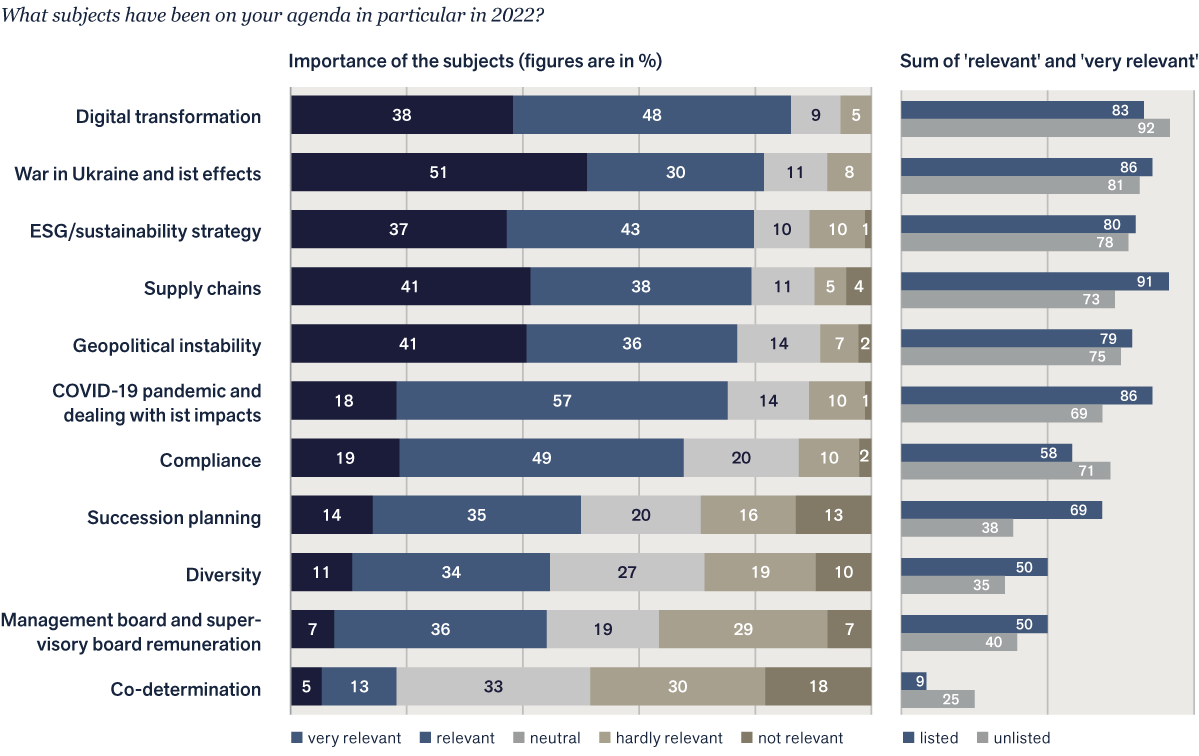
This combination of permanent crisis management, establishing resilience and working on the future of their companies will consume the attention of supervisory boards for some considerable time. This is hardly surprising. After all, dealing with crisis issues has already become part of their day-to-day business – whether it be adjusting to a recessionary economy or handling conventional energy supply shortages. Our study also shows that the issue of sustainability is now more and more apparent in how supervisory boards are organised. In that context, calls for particular expertise in sustainability are now being taken into account, as recommended by the German Corporate Governance Code, for example. A narrow majority (51 per cent) of respondents believe that their companies already meet this requirement. At listed companies, the figure is notably higher, at 62 per cent.
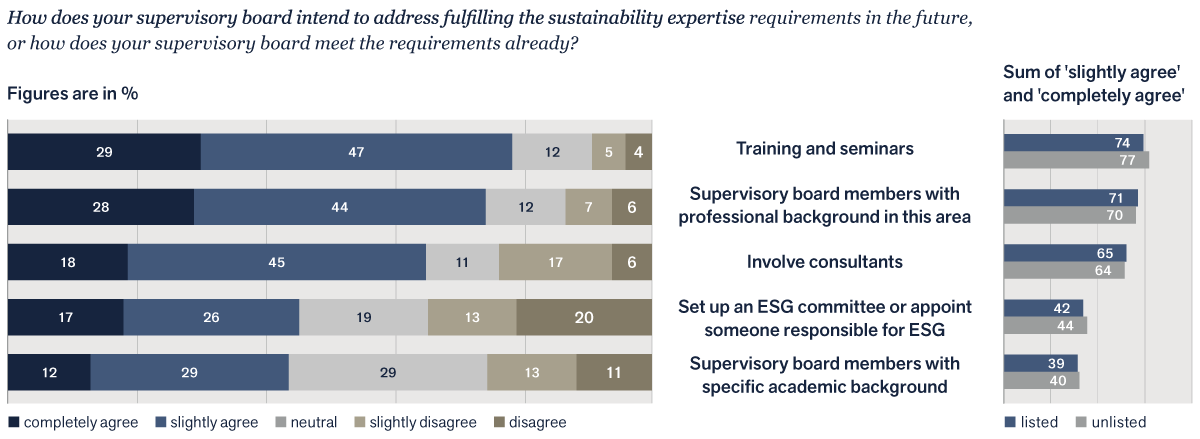
Supervisory boards are tackling sustainability expertise requirements in entirely different ways. More than three quarters of board members surveyed (76 per cent) currently view training and seminars as the best means of education. While 72 per cent look to appoint board members with a professional background in this area, 63 per cent would involve external consultants. By contrast, dealing with ESG topics by establishing committees or appointing individuals to oversee sustainability matters is not currently the norm. Only 12 per cent of survey participants said that they had opted for such a solution on their boards. It is still typical for the full supervisory board to handle ESG matters, according to 58 per cent of respondents. But a dynamic shift has become evident when it comes to assigning responsibility on supervisory boards for the key business challenge of sustainability. Companies such as Allianz, Bayer, Covestro, Deutsche Börse, Deutsche Post, e.ON, Qiagen, MunichRe, Puma, SAP, Zalando, RWE, EON, Hello Fresh and LEG are now setting up ESG committees or functions specifically to address the issue, which shows that it is not just relevant for companies of a certain critical size or for those operating in certain sectors.
Establishing technical expertise on the supervisory board to monitor and advise management effectively is in the company's best interest - and of paramount importance. We have also seen that institutionalised know-how on sustainability, in whatever form, is another key component in the growing professionalisation of the work done in this area by supervisory boards. This development is critical for the future viability of Germany as a centre of international business. Ultimately, in addition to fulfilling its monitoring function, the supervisory board is involved in shaping the company's fundamental decisions when determining the future direction of its business. The ongoing transformation of supervisory boards is also reflected in their make-up. As demonstrated by a significant body of research, the boards of big companies listed on the DAX, MDAX and other indices, have never been more international or more balanced in their gender composition than they are today. That gives cause for hope.
A gathering storm on the economic horizon and an imminent recession will do nothing to alter the strategic significance of sustainability. Reining in ambitions or putting projects on hold cannot be the answer. On the contrary, now is precisely the right time to invest more. ESG is not a luxury issue, but a critical factor for the future viability and resilience of companies, and in turn, our national economy.